The Disappearing Male Storyline
Men’s Day wrapped up with hashtags and feel-good messaging' but the narrative underneath remains untouched. Because cinema doesn’t just reflect culture, it rewires it. And somewhere along the way, exaggerated masculinity became normal. This piece examines how that happened — and why the missing middle matters.
JOURNALISTIC FEATURE ARTICLE
Sukanchan Majee
11/23/20254 min read
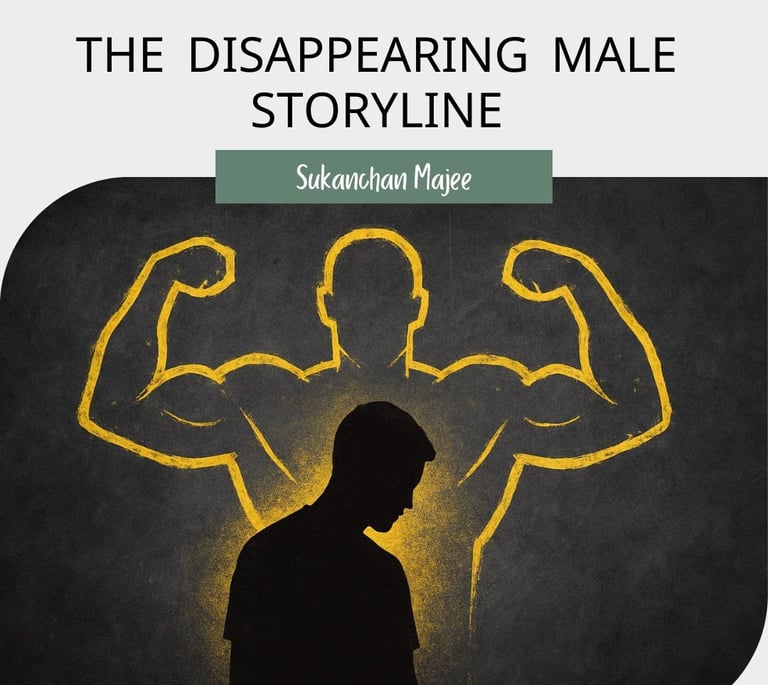
The average Indian man is not a walking explosion or a flawless hero. He is someone trying... sometimes clumsily, sometimes courageously - to navigate expectations that constantly contradict each other.
As the saying goes, “A man is not a mountain, but he carries one.” Yet our literature, cinema, and cultural stories rarely show that weight. They portray either the dramatic collapse or the dramatic victory and never the quiet, exhausting act of carrying.
And this has consequences. When storytellers stop giving men the space to be human, audiences stop expecting humanity from them. We begin responding to real men the way we respond to the exaggerated figures on screen, with suspicion, impatience, and demands no ordinary person can fulfill.
Masculinity has become an everyday topic, woven into Instagram reels, dinner-table debates, podcasts, morning walks, and late-night group chats. But these conversations rarely offer understanding. They come in the form of relentless instructions:
Be strong, but not too strong.
Be sensitive, but without making anyone uncomfortable.
Express yourself, but not too much.
Be confident, but not intimidating.
Be protective, but never overpowering.
Be soft, but only in approved ways.
Young men are pulled in opposite directions, stretched by expectations that would overwhelm anyone. And instead of acknowledging this confusion, instead of allowing them to be uncertain, imperfect, or in transition — our stories choose extremes.
The real damage, however, isn’t cinematic; it’s emotional.
Because when men are reduced to stereotypes, empathy for them slowly erodes. Their inner struggles become invisible. Their silences are mistaken for arrogance rather than fear. Their uncertainty looks like weakness. And vulnerability appears unnatural, while aggression feels inevitable.
Whether intentionally or not, cinema is teaching society to misread most men it encounters, and to miss the human being beneath the performance.
Bollywood’s Extremes Are Not Just Characters, They Are Signals
What pops up in your mind when you hear about Ayushman Khurana’s character in most of his movies? Or when you think about male characters in Kabir Singh, Animal or Pushpa?
Two extremes and why do they matter…?
What makes these extremes important is not just the storytelling shift, it is their reach. The titles that humanise masculinity rarely cross ₹50–100 crores. They find niche audiences, quiet appreciation, critical essays, film festival panels; but not mass cultural saturation. Meanwhile, the films driven by extreme masculinity - whether violent or saint-like - dominate the box office, streaming trends, Instagram reels, gym culture, even dating behaviour. Animal, Kabir Singh, Pushpa, KGF, Jawan, War, Uri, Bahubali… these aren’t just movies. They become reference points. They enter slang, posture, fashion, voice modulation, even moral frameworks. Their success means their grammar becomes the grammar of masculinity for millions.
Hit films are never just entertainment. They are broadcast systems.
And that is where the concern begins.
Because when the most commercially successful stories repeatedly present men at extremes, either irredeemably dangerous or impossibly divine; masculinity stops being a spectrum and becomes a binary. The subtle becomes invisible. The human becomes inadequate. The middle ‘vulnerable, ordinary, emotionally developing’ starts to look like failure. When complexity isn’t aspirational, audiences begin seeking identity in exaggeration. And exaggeration is easier to imitate than nuance.
From a sociological lens, repeated exposure builds normalization. Studies in media psychology call this process behavioural mirroring and identification modelling. The adolescent brain responds not to realism, but to spectacle. Not to balance, but to intensity. So when a character who smokes, drinks, rages, punches, bleeds, broods and dominates gets framed as powerful, misunderstood, and desirable - it creates a blueprint. On the opposite spectrum, when another male character is pure, sacrificial, morally invulnerable and emotionally bulletproof - that too becomes a template, an unreachable pedestal.
The issue isn’t that these characters exist. Cinema has always created myths. The issue is that in current mainstream storytelling, the myth has replaced the human.
And because these films travel beyond theatres through memes, reels, edits, bootleg shorts, fan accounts, and algorithmic worship… they don’t remain fiction. They become behavioural suggestions. A silent message repeats:
A real man must be exceptional.
He must be large enough to intimidate or pure enough to idolise. Anything softer is dismissed as weak; anything ordinary is dismissed as forgettable.
So yes, it matters. Because these aren’t fringe stories sitting on the side-lines of cultural consumption. These are the stories breaking records, entering households, and turning into social vocabulary. And unless the audience understands that cinema is exaggeration, not instruction, the line between representation and aspiration dissolves.
The danger isn’t that films are extreme. The danger is that only extremes are allowed to become iconic.
What’s the point?
So the question isn’t whether extreme male portrayals should disappear. They have a place- as archetypes, metaphors, symbols of collective psychology. The concern is that they have become dominant, commercially validated narratives without balance. Media research repeatedly shows that when a single model of gender is amplified, it does not remain entertainment, it becomes expectation.
Masculinity deserves the same narrative diversity women are finally beginning to receive: flawed, layered, confused, learning, inconsistent, tender. Not just mythic or monstrous.
Cinema doesn’t just tell stories; it trains imagination. And imagination, when repeated often enough, becomes belief and sometimes even identity.
Which means it is not just filmmakers who must correct the imbalance. It is all of us- viewers, critics, platforms, and cultural gatekeepers.
Because what we reward becomes what gets reproduced.